
Taxi 2 File
Taxi 2 (2000), written by Luc Besson and directed by Gérard Krawczyk, is a high-octane celebration of French action-comedy that successfully amplifies the formula of its predecessor. While the first film established the unlikely partnership between the speed-demon taxi driver Daniel (Samy Naceri) and the bumbling police officer Émilien (Frédéric Diefenthal), the sequel takes the stakes global, pitting the duo against the Japanese Yakuza in a plot involving international diplomacy and high-tech automotive stunts.
The film’s greatest strength lies in its relentless pacing. From the opening sequence—a literal race against a rally car—the movie signals that it isn't interested in realism, but rather in the "cool factor" of Daniel’s modified Peugeot 406. The car itself becomes a character, now equipped with wings for gliding and more sophisticated gadgets that push the film into the realm of urban fantasy. This shift mirrors the era’s fascination with "tuned" car culture, making it a stylistic cousin to the early Fast & Furious franchise. Taxi 2
However, beneath the screeching tires and slapstick, the film maintains a core of genuine chemistry. The dynamic between Daniel and Émilien works because they represent two sides of the same coin: one possesses the skill but lacks authority, while the other has the badge but lacks competence. Their friendship provides the necessary grounding for a film that otherwise operates at 200 miles per hour. Taxi 2 (2000), written by Luc Besson and
In conclusion, Taxi 2 is a quintessential popcorn flick that defined French commercial cinema at the turn of the millennium. It doesn't aim for deep philosophical insights; instead, it delivers a vibrant, stylish, and genuinely funny experience. By doubling down on the stunts and the absurdity of its characters, it secured its place as a cult classic of the action genre. From the opening sequence—a literal race against a
Thematically, Taxi 2 leans heavily into cultural caricature and slapstick humor. The plot centers on the kidnapping of a Japanese Minister of Defense during a visit to Marseille. This setup allows for a comedic clash of cultures, often at the expense of the inept French police force, led by the hilariously manic Commissioner Gibert (Bernard Farcy). Gibert’s "Operation Ninja" remains one of the film's comedic highlights, showcasing the series’ signature brand of organized chaos.
eFatigue gives you everything you need to perform state-of-the-art fatigue analysis over the web. Click here to learn more about eFatigue.
Taxi 2 File
Welds may be analyzed with any fatigue method, stress-life, strain-life or crack growth. Use of these methods is difficult because of the inherent uncertainties in a welded joint. For example, what is the local stress concentration factor for a weld where the local weld toe radius is not known? Similarly, what are the material properties of the heat affected zone where the crack will eventually nucleate. One way to overcome these limitations is to test welded joints rather than traditional material specimens and use this information for the safe design of a welded structure.
One of the most comprehensive sources for designing welded structures is the Brittish Standard Fatigue Design and Assessment of Steel Structures BS7608 : 1993. It provides standard SN curves for welds.
Weld Classifications
For purposes of evaluating fatigue, weld joints are divided into several classes. The classification of a weld joint depends on:
- the macroscopic geometry of the pieces welded,
- the direction of the cyclic stresses, and
- the location of the crack that leads to failure.
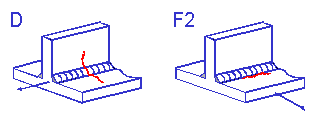
Two fillet welds are shown below. One is loaded parallel to the weld toe ( Class D ) and the other loaded perpendicular to the weld toe ( Class F2 ).
It is then assumed that any complex weld geometry can be described by one of the standard classifications.
Material Properties
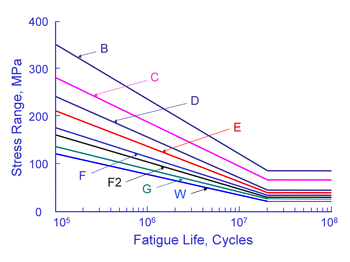
The curves shown above are valid for structural steel welds. Fatigue lives are not dependant on either the material or the applied mean stress. Welds are known to contain small cracks from the welding process. As a result, the majority of the fatigue life is spent in growing these small cracks. Fatigue lives are not dependant on material because all structural steels have about the same crack growth rate. The crack growth rate in aluminum is about ten times faster than steel and aluminum welds have much lower fatigue resistance. Welding produces residual stresses at or near the yield strength of the material. The as welded condition results in the worst possible residual or mean stress and an external mean stress will not increase the weld toe stresses because of plastic deformation. Fatigue lives are computed from a simple power function.

The constant C is the intercept at 1 cycle and is tabulated in the standard. This constant is much larger than the ultimate strength of the material.
The standard is only valid for fatigue lives in excess of 105 cycles and limits the stress to 80% of the yield strength. Experience has shown that the SN curves provide reasonable estimates for higher stress levels and shorter lives. In eFatigue, the maximum stress range permitted is limited by the ultimate strength of the material for all weld classes.
Design Criteria
Test data for welded members has considerable scatter as shown below for butt and fillet welds.
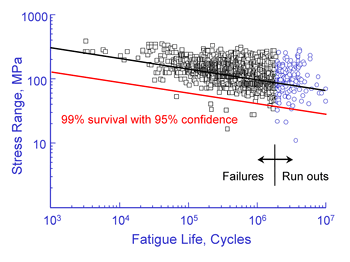
Some of this scatter is reduced with the classification system that accounts for differences between the various joint details. The standard give the standard deviation of the various weld classification SN curves.
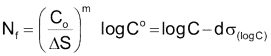
The design criteria d is used to determine the probability of failure and is the number of standard deviations away from the mean. For example d = 2 corresponds to a 2.3% probability of failure and d = 3 corresponds to a probability of failure of 0.14%.
© 2026 — Sharp Simple Spoke